
Quick answer: Overhead water tank cleaning in Islamabad covers plastic and cement rooftop tanks. We drain the tank, remove sludge and algae, scrub the walls and floor without scratching plastic, disinfect, rinse and refill. A plastic overhead tank usually takes 1 to 1.5 hours. Call +92 332 5063036 to book.
Why do rooftop tanks get dirty?
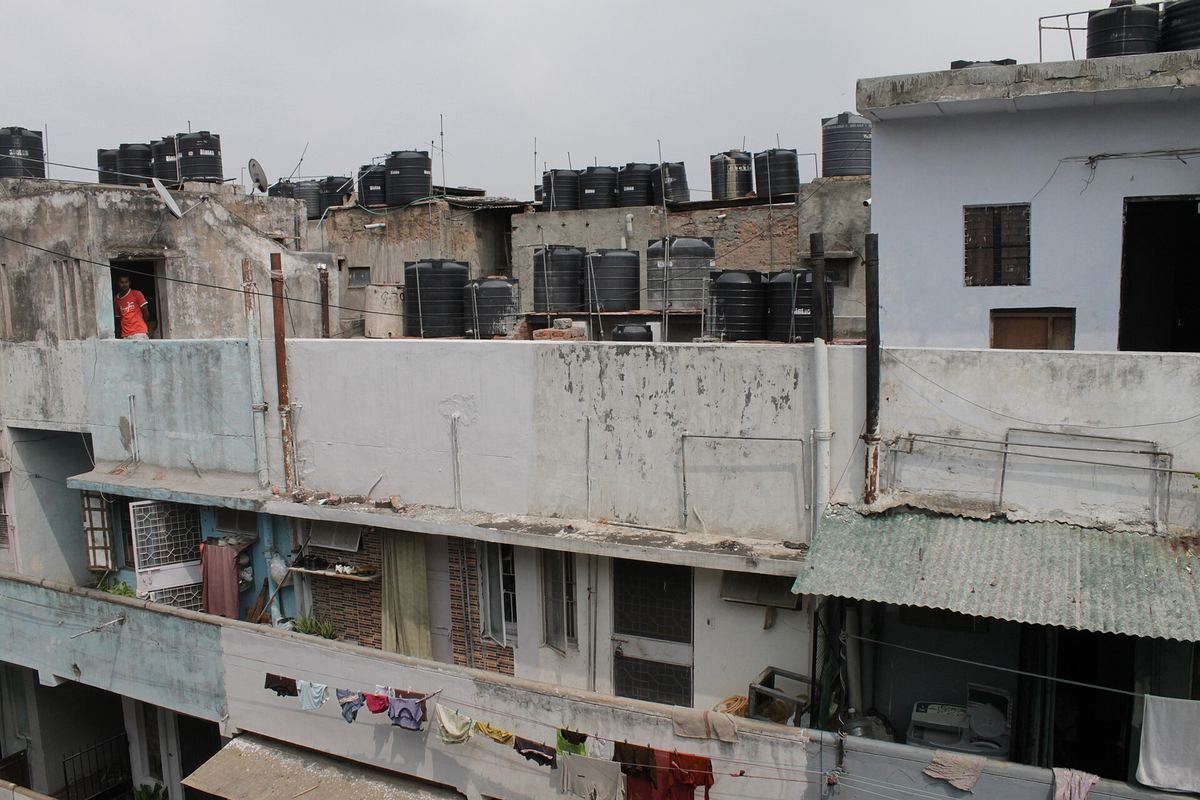
The rooftop tank is the last stop before water reaches your taps, the tootiyan. Water arrives there from the underground tank, already carrying whatever sediment the underground tank did not catch. Then the roof adds its own problems: sun and heat.
Sunlight and heat feed algae, or kai, in rooftop tanks. Islamabad summers reach a June mean maximum of 38.3 degrees Celsius, and a dark plastic tank on a roof gets hotter still. Algae grows on the walls as a green or black slime, and it comes back faster if the lid is cracked or loose and lets light in. Dust blows in through a loose lid, or tanki ka dhakkan, and settles on the water. In the monsoon, silt-laden water from Simly Dam, Khanpur Dam and Rawal Lake brings in extra mud, or keechar.
That is why a rooftop tank can look clean from the outside and still be dirty inside. The signs show up at the tap first: gadla pani, or murky water, a musty smell, grit in the water, or green or black slime on the tank walls when the lid is lifted.
What kind of overhead tank do you have?
Most rooftop tanks in Islamabad are plastic, moulded plastic or fibre. They are lighter, easier to fit on a roof, and easier to scrub. Older houses, especially in the F-sectors and G-sectors, often have cement rooftop tanks, built in place on the roof. Both types hold the same water, but they are cleaned differently, and the difference matters.
Plastic scratches easily. A wire brush leaves scratches that hold dirt and algae, so the tank gets dirty faster after the next clean. Plastic tanks are scrubbed with soft, material-matched brushes, never a wire brush. Cement is porous and rough, so it holds more sludge in its pores and corners, and it usually needs pressure washing. The full comparison is on the plastic vs concrete water tank cleaning page.
How is an overhead tank cleaned?
The work follows eight steps. The overhead tank is the quicker of the two tanks in most houses, because it is smaller and easier to reach than the underground tank.
- Drain the stored water. Use the stored water first, or drain the tank through its outlet. The tank is emptied so the team can reach the floor.
- Remove the sludge. Sludge and algae are removed by hand, bucket or sludge pump. The sludge is taken away, not flushed into your drains.
- Scrub the walls and floor. Soft brushes for plastic, pressure washer for cement. Walls, floor, corners and joints are scrubbed, not just rinsed, because a rinse alone leaves the slime behind.
- Clean the lid, inlet and overflow. The lid, inlet pipe and overflow are cleaned and checked. A cracked or loose lid lets dust, insects and rainwater in. The float valve is checked too, because a broken float valve can overflow the tank.
- Disinfect. A chlorine-based solution is applied at drinking-water dosage and left for contact time, the time the disinfectant needs to work.
- Rinse until clear. The tank is rinsed, and rinsed again, until the water runs clear.
- Vacuum out the remaining water. A wet vacuum removes the last rinse water from the floor so no dirty water is left behind.
- Refill. The tank is refilled and the lid is reseated. Before the lid goes back, you can look inside and see that the bottom is free of mud.
How big are overhead tanks, and how long does cleaning take?
| Tank size | Tank material | Typical time |
|---|---|---|
| 100 to 300 gallons | Plastic | 1 to 1.5 hours |
| 400 to 500 gallons | Plastic | 1 to 1.5 hours |
| 500 to 1,000 gallons | Plastic | 1.5 to 2 hours |
| 6x6 to 8x8 ft | Cement | Part of a 3 to 5 hour visit |
| 10x10 ft and larger | Cement | Part of a 3 to 5 hour visit |
The 1 to 1.5 hour figure for a plastic overhead tank, and the 3 to 5 hour figure for a cement tank or both tanks together, come from the Muhammad Technical Services guide (Nov 2026). The water is off while the tank is drained, cleaned and refilled, so plan the visit around your supply hours. Most houses clean the overhead and underground tanks in one visit, which takes 3 to 5 hours in total.
How much does overhead tank cleaning cost?
Overhead tanks usually cost less than underground tanks, because they are smaller and easier to reach. No Islamabad provider publishes a fixed price by tank type and size, so the honest answer is a provider-published range, with the source labelled.
| Tank | Provider-published range | Source |
|---|---|---|
| Plastic overhead, 100 to 300 gallons | PKR 1,500 to 2,500 | Muhammad Technical Services, Nov 2026 guide |
| Plastic overhead, 400 to 500 gallons | PKR 2,000 to 3,500 | Muhammad Technical Services, Nov 2026 guide |
| Cement overhead, 6x6 to 8x8 ft | PKR 2,500 to 4,500 | Muhammad Technical Services, Nov 2026 guide |
| Cement overhead, 10x10 ft and larger | PKR 4,500 to 7,000 and above | Muhammad Technical Services, Nov 2026 guide |
| Both tanks, typical house | PKR 5,000 to 10,000 | Muhammad Technical Services, Nov 2026 guide |
| Overhead, from | From PKR 3,500 | Moawin Facilities |
| Domestic, up to 1,000 gallons, from | From PKR 1,500 | Care Taker, I-8 |
These are provider-published ranges, not our fixed price. What changes the price is the tank size, whether it is plastic or cement, how much sludge and algae have built up, and how easy the roof is to reach. Cleaning both tanks together usually costs less than booking them separately. The full breakdown is on the water tank cleaning cost page, and the exact quote for your tank comes on the call.
How do I check my tank size?
Most plastic tanks have the size moulded into the side, in litres or gallons. Common sizes are 100, 200, 300, 500 and 1,000 gallons, which is roughly 500, 1,000, 1,500, 2,500 and 5,000 litres. If the size is not marked, measure the height and diameter, or send a photo of the tank and its label, and we will work out the size on the call. Cement tanks are measured in feet, length by width by depth, for example 6x6 ft or 10x10 ft.
How often should a rooftop tank be cleaned?
| Water source | How often |
|---|---|
| CDA or municipal water | Every 6 months |
| Bore water | Every 3 to 6 months |
| Tanker water | Every 3 to 4 months |
| After the monsoon | Clean right after, whatever the schedule |
| Before summer | Book in March or April, before the heat |
The rooftop tank should be cleaned on the same schedule as the underground tank, because dirty water from the underground tank is pumped straight up to the roof. Cleaning only the rooftop tank leaves the source of the dirt untouched. The full guide is on the how often to clean your water tank page.

What about roof access and safety?
Rooftop work needs safe access: a sound staircase or ladder, a dry roof, and room to work around the tank. Tell us on the call if the roof is hard to reach, if the tank sits on a fourth floor, or if the ladder is steep or damaged. If the tank cannot be reached safely, we will say so honestly rather than taking the risk.
What is not included?
Cleaning does not include crack repair, valve or motor replacement, waterproofing, lab water testing, or unblocking pipes. If we see a crack, a leaking joint or a broken fitting while cleaning, we point it out so you can arrange a repair. Cleaning also does not remove arsenic, TDS or hardness from water. It removes sludge, sediment, algae and the dirt that builds up inside the tank.
What to have ready when you call
Four things make the call short and the quote accurate: your tank type (overhead, underground, or both), your tank size in gallons, litres or feet, your area or sector, and a photo of the tank and its lid if you can take one. If the lid opens, a photo of the inside helps even more. With those four things, we can give you a fixed quote before work starts.
Related pages: underground water tank cleaning, all water tank cleaning services, signs your tank needs cleaning.
Frequently asked questions
A plastic overhead tank usually takes 1 to 1.5 hours. A cement overhead tank takes longer, and an overhead and underground tank cleaned together usually takes 3 to 5 hours. The water is off while the tank is drained, cleaned and refilled.
Provider-published ranges from the Muhammad Technical Services guide of Nov 2026 put a plastic overhead tank of 100 to 300 gallons at PKR 1,500 to 2,500, and 400 to 500 gallons at PKR 2,000 to 3,500. A cement overhead tank of 6x6 to 8x8 feet is PKR 2,500 to 4,500. The exact quote comes on the call.
Sunlight and heat feed algae, or kai, in rooftop tanks. Islamabad summers reach a June mean maximum of 38.3 degrees Celsius, and a dark plastic tank on a roof gets hotter still. Algae grows on the walls as a green or black slime, and it comes back faster if the lid is cracked or loose and lets light in.
No. A wire brush scratches plastic, and the scratches hold dirt and algae, so the tank gets dirty faster after the next clean. Plastic tanks are scrubbed with soft, material-matched brushes. Cement tanks are the ones that usually need pressure washing.
Every 6 months for homes on CDA or municipal water, every 3 to 6 months for bore water, and every 3 to 4 months for tanker water. Clean right after the monsoon as well, and book a clean before summer, in March or April, because heat speeds up algae growth.
Yes. The lid, inlet, overflow and float valve are cleaned and checked as part of the job. A cracked or loose lid lets dust, insects and rainwater in, and a broken float valve can overflow the tank. If we see a problem, we point it out so you can arrange a repair.
Hours: 9 AM - 5 PM. Address: Bahria Town Phase 4, Islamabad, 46220, Pakistan.